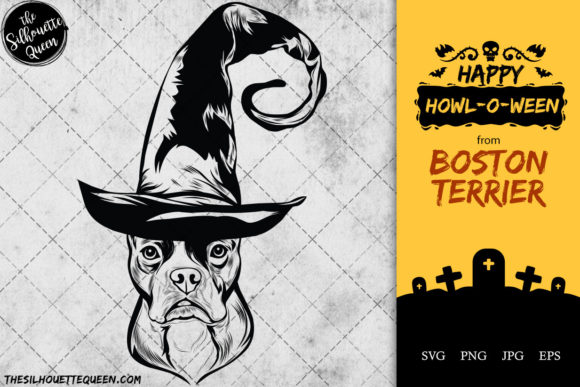
Boston Terrier Dog in Witch Hat
A Playful, Polished Silhouette That Stitches Clean—If You Know Where to Place It
As someone who’s stitched hundreds of dog-themed designs—from delicate puppy portraits to bold breed silhouettes—I opened Boston Terrier Dog in Witch Hat expecting whimsy, and got something more useful: a confident, well-proportioned graphic with real embroidery legs. It’s not just cute—it’s *craft-ready*. I tested it on a medium-weight cotton tote bag for a local pet boutique’s Halloween pop-up, and the result landed exactly where it should: charming but not cloying, festive but not fleeting.
First Impression: Personality Without Clutter
The design balances character and clarity. The Boston Terrier’s compact head, perky ears, and expressive eyes read instantly—even at 3.5 inches tall. The witch hat sits cleanly atop the skull, not floating or overlapping awkwardly. There’s no excessive linework, no tiny facial details that’ll vanish under satin stitch, and no thin connectors that’ll snap during hooping. It’s a single-layer graphic, built for clean fill and outline work—not applique or multi-step layering. That makes it ideal for quick-turn projects: embroidered patches, sweatshirt chest logos, baby onesie accents, or tea towel monograms.
Where It Shines (and Where It Needs Guardrails)
Shines on:
- Medium-to-heavy fabrics: Sweatshirts, canvas totes, denim jackets, and linen pillow covers hold the shape beautifully. The design’s moderate stitch density doesn’t overwhelm stable weaves.
- Flat, smooth surfaces: Tote bags, aprons, and flat-front caps (think structured dad hats) let the witch hat’s brim and terrier’s snout stay crisp.
- Personalized gifts: A small batch of embroidered baby blankets or nursery pillows with this design feels intentional—not generic. Customers recognize the breed *and* the holiday nod without needing explanation.
- Etsy listings and craft fair displays: As a digital embroidery file, it converts cleanly into printable mockups. I dropped the PNG into a lifestyle shot of a black tote—and it looked like a finished product, not a placeholder.
Use carefully on:
- Stretchy knits (t-shirts, ribbed baby bodysuits): The clean lines hold up, but you’ll need cutaway stabilizer and precise hooping. Skip the witch hat’s pointed tip if stitching below size 2.75" — it risks distortion on curved seams.
- Dark or textured fabrics: The JPG and PNG files show strong contrast, but test thread colors against your actual fabric. A light gray thread on charcoal fleece reads softer than expected—go one shade brighter or add a white underlay.
- Tiny hoops (under 4"): The witch hat’s brim and terrier’s collar detail compress well down to ~3", but avoid going smaller unless you’re using it as a subtle accent (e.g., corner of a kitchen towel).
- Frequent-wash items (baby bibs, kids’ tees): Stitch density feels balanced—not too sparse, not overfilled—but always pair with quality polyester thread and a tear-away + cutaway hybrid stabilizer for longevity.
Design Assets That Support Real Workflow
The inclusion of EPS, SVG, PNG, and JPG files isn’t just format padding—it’s practical flexibility. I used the SVG to resize cleanly for a 5x7 hoop patch, the PNG for a social media preview, and the JPG for a quick client email proof. No pixelation, no jagged edges, no guesswork about vector integrity. For craft business owners juggling Etsy uploads, wholesale line sheets, and in-person craft fair signage, that consistency matters. It means one design asset does double duty: as a machine embroidery file *and* as polished visual branding.
What This Design Says About Your Finished Product
When customers see Boston Terrier Dog in Witch Hat stitched on a handmade item, they don’t just register “dog” and “Halloween.” They register *intention*. This isn’t a clipart afterthought—it’s a curated detail. That lifts perceived value on small shop products: a $28 embroidered apron feels like a boutique piece, not a craft-fair impulse buy. For Etsy sellers, it adds quiet professionalism to listings—especially when paired with thoughtful mockups showing the design on both light and dark backgrounds.
It also builds trust. Pet owners spot authenticity fast. A correctly proportioned Boston Terrier (not a generic “pug-like” silhouette) tells them you understand the breed—and by extension, you care about accuracy in your craft business. That translates to repeat orders, better reviews, and word-of-mouth referrals among dog-loving communities.
Practical Designer Notes Before You Stitch
- Always test on scrap fabric first—especially if using textured or stretchy material. Check how the hat’s point and the terrier’s ear tips hold up.
- Review stitch density visually before loading into your embroidery software. Dense fills look great on canvas but can pucker thin cotton.
- Confirm hoop size compatibility—the design scales well, but verify your smallest usable size matches your most common hoop.
- Inspect small details in black-and-white mockups. Does the witch hat’s band still read clearly against dark fabric? Does the terrier’s eye retain shape on light fabric?
- Use proper stabilizer for your fabric type—no shortcuts on baby items or high-wear apparel.
- Check licensing terms before selling finished items or digital products. Since this is listed as a Graphics product in Crafts, confirm whether commercial use is included—or if you need an extended license for resale.
In short: Boston Terrier Dog in Witch Hat is a quietly versatile embroidery file—not flashy, but dependable. It works as hard on a custom embroidered sweatshirt as it does on a boutique baby blanket or a limited-run holiday patch. It’s the kind of design that disappears into your workflow, then reappears as a customer favorite. Just remember: even the best embroidery file needs smart execution. Test, stabilize, scale thoughtfully—and let the terrier do the rest.