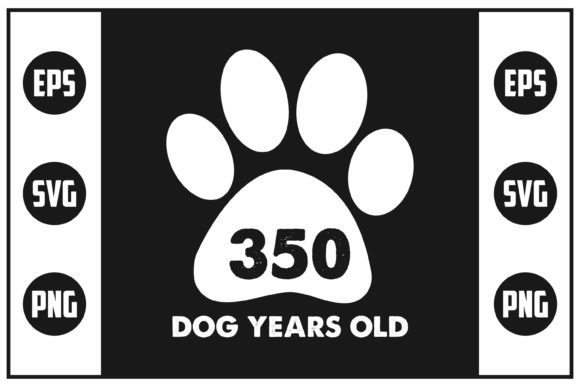
350 Dog Years Old
A Playful, Punchy Phrase That Stitches Well—If You Know Where to Place It
I pulled up 350 Dog Years Old last week while prepping a batch of custom embroidered tote bags for a local dog rescue’s fundraiser. The client wanted something lighthearted but not cutesy—something that nodded to canine devotion without leaning into cartoon puppies or paw prints. Right away, the phrase landed: warm, witty, and instantly readable. As a designer who’s stitched thousands of text-based embroidery files over 12 years, I don’t just scan for aesthetics—I ask: Will this hold up under thread? Will it read clearly at 3 inches wide on a textured canvas tote? Will customers smile *and* understand it in under two seconds? For 350 Dog Years Old, the answer is yes—but with thoughtful placement.
First Impression: Bold Simplicity With Personality
The design feels like a friendly inside joke made tangible: clean sans-serif lettering, generous spacing, no extraneous flourishes. It’s not an appliqué design or a layered satin-stitch monogram—it’s a single-line, high-contrast phrase built for legibility. That makes it ideal for machine embroidery projects where clarity trumps complexity: baby onesies, tea towels, aprons, and minimalist sweatshirt fronts. There’s no tiny script to vanish in fill stitch, no delicate serifs that’ll blur on cotton twill. What you see in the SVG preview is essentially what you’ll get in thread—provided your digitizing (or the source file’s digitization) respects basic embroidery logic.
Where It Shines in Real Projects
- Custom apparel: Works beautifully on mid-weight cotton or fleece—especially on the left chest of crewneck sweatshirts or the center front of relaxed-fit tees. The rhythm of “350 Dog Years Old” gives natural visual weight without crowding.
- Tote bag design: Stitched at 4.25" wide on natural canvas, it reads cleanly from across a craft fair aisle. No need to add outlines or shadows—the letterforms carry their own presence.
- Baby embroidery: On a soft organic cotton receiving blanket or knit romper, it reads as sweetly irreverent—not too loud, not too small. Just right for the parent who’d rather say “350 Dog Years Old” than “World’s Best Dog Mom.”
- Holiday embroidery & personalized gifts: Pair it with a simple bone icon or paw outline (added separately) on a linen pillow cover or ceramic mug wrap—and it becomes a quietly confident holiday gift for the lifelong dog person.
- Craft business & Etsy seller use: As a digital embroidery file, it slots neatly into product bundles (“Dog Lover Collection”), printable mockups, and small shop branding—especially when paired with cohesive fonts and neutral thread palettes.
Where to Use It Thoughtfully
This isn’t a one-size-fits-all embroidery file—and that’s a good thing. Its strength is its restraint, so it needs context to land. Avoid using 350 Dog Years Old on:
- Curved surfaces like caps or beanies—unless resized and re-digitized for stability (the original SVG alone won’t compensate for crown distortion).
- Stretchy fabrics like jersey or ribbed knits without proper cutaway stabilizer—letter spacing can gape if tension shifts.
- Dark fabric without testing thread contrast first—white or cream thread pops, but pale yellow or light gray may disappear.
- Small hoop sizes under 4” diameter—tight kerning between “350” and “Dog” means shrinking too far risks muddying the numeric transition.
- Frequent-wash items like kitchen towels or baby bibs—unless you verify stitch density supports durability (a quick test stitch on scrap fabric tells you more than any spec sheet).
What It Adds to Your Finished Product—Beyond the Thread
Good embroidery design doesn’t just look right—it builds trust. When a customer sees 350 Dog Years Old cleanly stitched on a handmade apron or boutique sweatshirt, they register craftsmanship, intention, and humor—all in one glance. It signals that the maker paid attention: to scale, to fabric behavior, to how words breathe in thread. That perception elevates perceived value, especially for Etsy sellers and small shop owners pricing handmade products at a premium. It also reinforces brand consistency—if your shop leans into dry wit and quality execution, this phrase becomes part of your visual vocabulary, not just decoration.
Practical Designer Notes Before You Stitch
- Test the design on scrap fabric matching your final project’s weight and texture—especially if using textured canvas, terry cloth, or lightweight linen.
- Check thread color contrast against both light and dark backgrounds—try black thread on oatmeal canvas and white thread on navy denim.
- Review stitch density in your embroidery software—if it looks overly dense in tight curves (like the “3” or lowercase “g”), consider slight simplification or added underlay.
- Confirm hoop size compatibility—some versions of this phrase may require a 5” x 7” hoop minimum depending on final width.
- Inspect small details in black-and-white mockups—what reads as charming in color might flatten into ambiguity without tonal variation.
- Use appropriate stabilizer: tear-away for stable wovens, cutaway for knits or loosely woven fabrics.
- If selling finished items commercially, verify licensing terms—this is a digital embroidery file, not a physical product, and commercial use rights depend on the creator’s stated policy.
Final Thought: A Design That Earns Its Keep
350 Dog Years Old isn’t flashy. It won’t dominate a tradeshow booth by itself—but stitched thoughtfully onto the right product, it becomes quietly unforgettable. It fits cleanly into Crafts and Graphics workflows alike, whether you’re building a holiday collection for your Etsy shop or embroidering 50 custom sweatshirts for a shelter gala. As a professional embroidery designer, I reach for files like this when I need reliability, charm, and zero guesswork. It’s not just a phrase. It’s a small, well-placed moment of recognition—for dogs, for people, and for the handmade care behind every stitch.